Industry and technology 1900–1915
Steelmaking in a McKeesport converter house
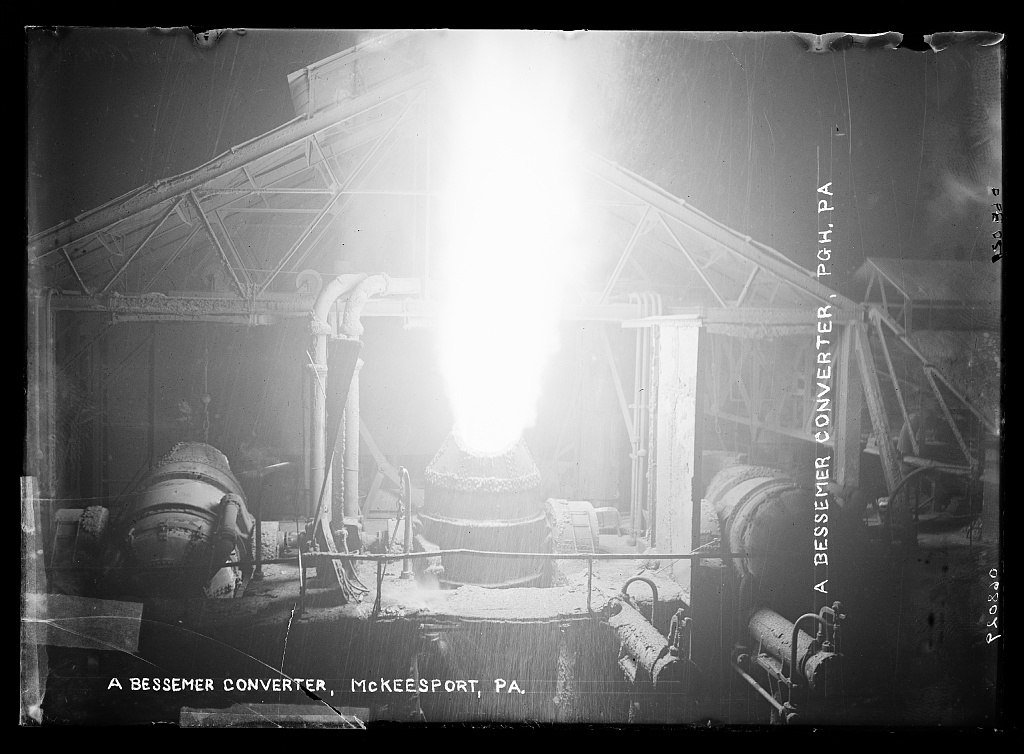
The Bessemer process changed steelmaking by blowing air through molten iron. Oxidation removed carbon and other impurities while producing heat, allowing large quantities of steel to be made quickly. In this photograph from McKeesport, Pennsylvania, the converter house becomes a dramatic arrangement of machinery, dark interior space and intense light. The city belonged to the Pittsburgh region’s industrial network, where mills, transport and labor were closely connected. Such photographs made heavy industry visually impressive; accounts of the workers and the process help explain the difficult, dangerous operations behind that spectacle.
About the picture
The converter held molten iron while a blast of air changed its composition. The bright discharge gives a glimpse of the heat and energy involved in making steel. Large industrial interiors were difficult photographic subjects, and this surviving negative records the machinery in sharply unequal areas of light and darkness.
The history behind it
The documented reconstruction
The specific identification is a Bessemer converter in McKeesport, Pennsylvania, dated within 1900–1915. Equipment naming is stronger evidence here than a guess from an overexposed-looking plume. The alternate Pittsburgh label should be reconciled with the more precise place, rather than used to manufacture a contradiction. The catalog also distinguishes damage to the photographic negative from conditions in the photographed plant. No calibrated temperature, charge chemistry, exact shift, wage record or accident report is supplied. This is an equipment-and-place identification with explicit limits, rather than a complete technical or labor history of the operation.
Reading the source
A brilliant plume can make a photograph feel technically self-explanatory, yet the equipment name is doing much of the real identifying work. The caption and catalog support Bessemer conversion rather than a guess based on light alone. The specific McKeesport title can also be retained alongside an alternate Pittsburgh abbreviation without forcing a false choice.
Questions for further research
The negative’s condition is a separate source problem. A catalog note about a crack and tape concerns the physical carrier of the image, not necessarily an incident in the industrial plant. Likewise, apparent brightness does not supply a calibrated temperature. Technical performance and labor conditions require measured records rather than confidence drawn from the photograph’s drama.
A few things to read next
Books for a longer visit, and a few good places to start online. These are ordinary links, with no affiliate commission.
On the bookshelf
Andrew Carnegie
The steel industry’s growth through the life of one of its most powerful owners.
The Rise and Fall of American Growth
How steel, electricity and other industrial changes altered American production and living standards.
The Gospel of Wealth Essays and Other Writings
A steel magnate’s own arguments about wealth and public responsibility, to read critically alongside labor history.
Read online
Bessemer process
A starting point for names, dates and related subjects. Follow its references when you want to go further.
Original pilot Bessemer converter, 1865
An early surviving converter and the engineering history of the process.
Bessemer converter in action
Another historical view, with an explanation of steel production from molten pig iron.
Where the pictures come from
The original records and their individual rights statements are below. The pictures have not been generated or altered for the game.
A Bessemer converter, McKeesport, Pa.
Library of Congress, Prints & Photographs Division · [between 1900 and 1915]
No known restrictions on publication.
An original editorial digest of the cited catalog facts; not a second historic eyewitness document.
Library of Congress, Prints & Photographs Division · Editorial digest reviewed 2026-11-01
Original Data Barnacle wording summarizing factual catalog data; underlying artifact rights are stated on the image.
History notes and reading lists prepared for Then & Found with AI assistance. The source institutions and authors are not sponsors or endorsers. Suggest a correction or another source