Journeys & public life 1940s
Esther Bubley’s wartime bus journey
Does the destination board locate the camera? Compare the signs with Bubley’s caption record, then defend the exposure place, date and claims about the terminal’s unequal use.
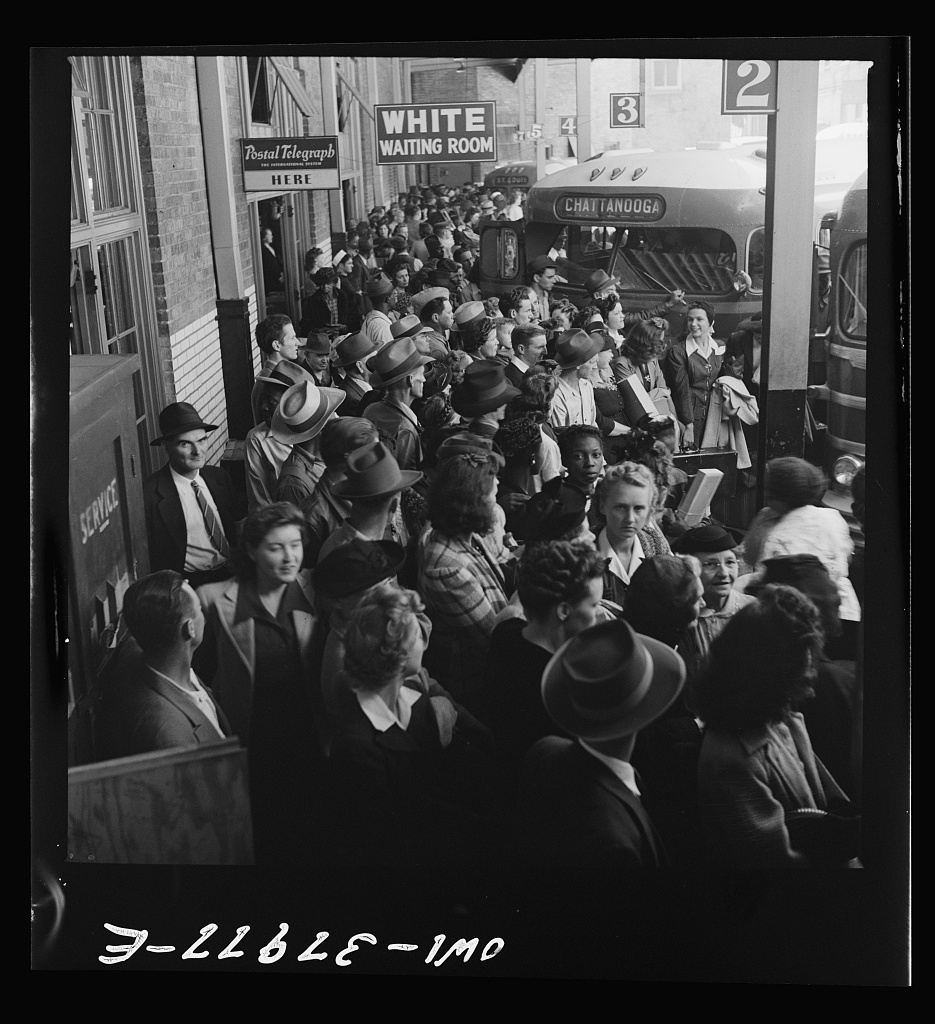
In 1943, the Office of War Information sent Esther Bubley out to photograph bus travel on the American home front. She paid attention to the spaces between departure and arrival: platforms, waiting rooms, rest stops and people carrying the ordinary burdens of a journey. This Memphis photograph compresses a crowd, a destination board and a segregated waiting-room sign into one frame. Wartime movement did not suspend Jim Crow. The photograph preserves a public system doing two things at once, carrying people across distances while imposing unequal rules on their use of shared space.
About the picture
The destination above the bus points toward a journey elsewhere, while the waiting-room sign governs space inside the terminal itself. Bubley’s vantage point brings these systems into the same picture. Its crowd includes individual lives the archive cannot fully recover, but the public lettering records rules and routes plainly.
The history behind it
A destination is not the camera’s location
The bus displays Chattanooga, but the Library of Congress identifies the photograph as passengers waiting at the Memphis terminal. These names perform different jobs: one points toward a journey, while the other identifies the recorded scene. Bubley’s picture shows how easily a prominent sign can lead a viewer away from the actual exposure location. Use the caption record alongside the visible lettering before deciding where the photographer and passengers were standing.
Sources: Library of Congress: Memphis terminal negative and caption record
The waiting-room sign records exclusion
The sign above the crowd reserves a waiting room for white people. It is evidence of an explicitly segregated public space, not a neutral decorative detail in a busy terminal. The Library’s subject headings also identify segregation. The lettering gives a firmer basis for interpreting an imposed rule than guessing individual passengers’ identities or thoughts from their faces. The frame records a system of unequal access without telling us every person’s experience of navigating it.
Sources: Library of Congress: Memphis terminal negative and caption record
Bubley photographed the home front through people
The Library’s exhibition describes Bubley’s recruitment into the Office of War Information after her photographs of Washington boarding-house life impressed Roy Stryker. Her government bus-travel assignment produced hundreds of pictures of ordinary Americans in wartime movement. Waiting rooms and platforms therefore belong to the assignment’s subject, alongside the journey itself. That context explains why this pause mattered to the project, while the particular arrangement of signs and people rewards looking closely at the individual frame.
Sources: Library of Congress: Esther Bubley’s home-front assignments
The caption, exposure month and later custody
The item record gives September 1943 and credits Esther Bubley. It says the title and other information came from a caption-sheet entry; a separate note records the negative’s transfer from the Office of War Information in 1944. Keep those documentary stages distinct. Neither the later transfer nor the repository’s Washington address moves the photographed encounter out of Memphis in 1943. The catalog anchors the scene while leaving the names and complete journeys of most passengers unrecorded.
Sources: Library of Congress: Memphis terminal negative and caption record
A few things to read next
Books for a longer visit, and a few good places to start online. These are ordinary links, with no affiliate commission.
On the bookshelf
Esther Bubley: On Assignment
A selection of Bubley’s photojournalism with the magazine contexts in which readers encountered it.
Freedom Riders: 1961 and the Struggle for Racial Justice
The later campaign against segregated interstate transport, clearly distinguished from the 1943 scene.
Read online
Esther Bubley
A starting point for names, dates and related subjects. Follow its references when you want to go further.
Women Come to the Front: Esther Bubley
Her early work in Washington and the government documentary assignment.
Esther Bubley, Waiting for the Bus at the Memphis Terminal
A close historical reading of this photograph, its composition and its social setting.
Where the pictures come from
The original records and their individual rights statements are below. The pictures have not been generated or altered for the game.
Waiting for the bus at the Memphis terminal; Esther Bubley, September 1943; LC-DIG-fsa-8d33404.
Library of Congress, Prints & Photographs Division, FSA/OWI Collection · September 1943
Public domain: LOC identifies the FSA/OWI black-and-white negatives as free to use and reuse; item has no known restrictions.
Modern editorial paraphrase of the cited archive records; not a second historical document.
Data Barnacle / Library of Congress, Prints & Photographs Division, FSA/OWI Collection · 2026-11-01
Original editorial paraphrase; underlying archive and photograph credited separately.
History notes and reading lists prepared for Then & Found with AI assistance. The source institutions and authors are not sponsors or endorsers. Suggest a correction or another source