Maritime engineering 1914
A floating dry dock at Valparaíso
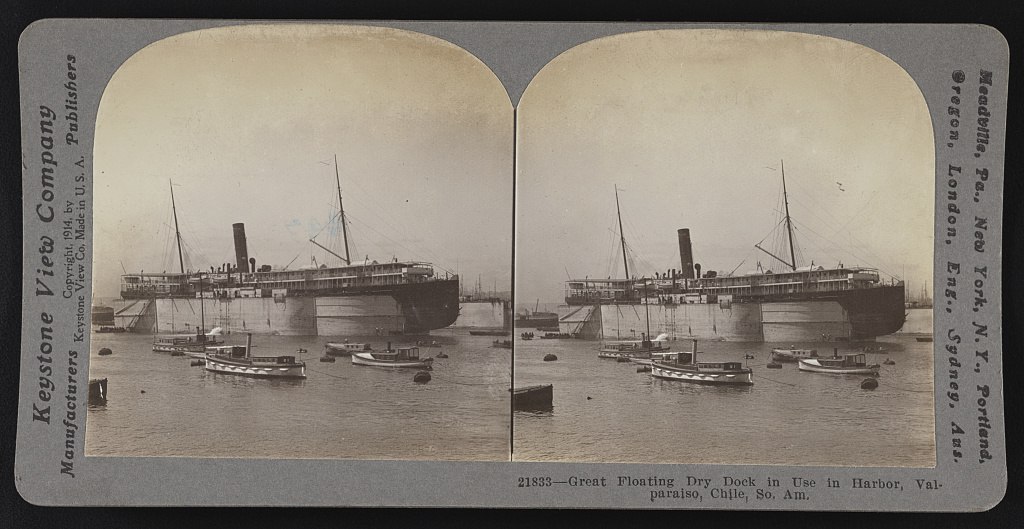
A ship normally hides much of its hull below the waterline. A floating dry dock makes that underwater surface accessible by lifting the vessel out of the water. The 1914 stereograph shows this work in Valparaíso, Chile, a major port in the ocean trading world of the late nineteenth and early twentieth centuries. Keeping vessels moving required more than quays and cargo handling: hulls needed inspection and repair. The dock places an often invisible part of port life in view, alongside the ships whose voyages depended on shore-based engineering and maintenance.
About the picture
A floating dry dock takes in water to sink low enough for a vessel to enter, then pumps it out to rise with the ship supported inside. The two photographs on this stereocard gave viewers a three-dimensional impression of the installation when seen through a stereoscope.
The history behind it
The documented reconstruction
This card documents a floating dry dock in use in Valparaíso harbor and is cataloged to 1914. Its duplicate-looking panels belong to the stereoscopic format, where a small viewpoint difference gives depth. They therefore do not establish that the dock rose, sank or changed ownership between exposures. The supported engineering identification comes from the raised dock-and-vessel arrangement read alongside the historic title. Repair purpose, exact water depth, financial arrangements and a minute-by-minute lifting sequence remain outside the packet. The archive’s modern cataloging activity is also not a reason to redouble the historical date.
Reading the source
Paired images are tempting evidence for change because they invite comparison. Here, however, the source format explains the duplication before any temporal interpretation is needed. Small viewpoint differences belong to a stereoscopic representation of a single harbor arrangement. The catalog title then supplies the functional description of the floating dock.
Questions for further research
A dock photograph is useful evidence of installation and use, but not a full repair file. To investigate the ship’s identity, work ordered, price or duration, a historian would need additional records securely tied to the vessel and date. The image cannot provide exact soundings or a lifting rate simply because water and machinery are visible. Historical format is itself evidence to interpret before assigning the panels a chronology.
A few things to read next
Books for a longer visit, and a few good places to start online. These are ordinary links, with no affiliate commission.
On the bookshelf
Strangers on Familiar Soil: Rediscovering the Chile–California Connection
Chile’s connections across the Pacific, including exchanges with California.
Bridging the Seas: The Rise of Naval Architecture in the Industrial Age, 1800–2000
The industrial development of ship design, materials and engineering.
Ships and Science: The Birth of Naval Architecture in the Scientific Revolution, 1600–1800
The earlier science of hull behavior, stability and naval architecture behind later maritime engineering.
Read online
Dry dock
A starting point for names, dates and related subjects. Follow its references when you want to go further.
Historic Quarter of the Seaport City of Valparaíso
Why Valparaíso became an important industrial-age international port.
Historic quarter of Valparaíso
The bay, narrow waterfront and steep hills that shaped the port city.
Where the pictures come from
The original records and their individual rights statements are below. The pictures have not been generated or altered for the game.
Great floating dry dock in use in harbor, Valparaiso, Chile, So. Am.
Library of Congress, Prints & Photographs Division · [1914]
No known restrictions on publication in the U.S. Use elsewhere may be restricted by other countries' laws. For general information see "Copyright and Other Restrictions ...," https://www.loc.gov/rr/print/195_copr.html
An original editorial digest of the cited catalog facts; not a second historic eyewitness document.
Library of Congress, Prints & Photographs Division · Editorial digest reviewed 2026-11-01
Original Data Barnacle wording summarizing factual catalog data; underlying artifact rights are stated on the image.
History notes and reading lists prepared for Then & Found with AI assistance. The source institutions and authors are not sponsors or endorsers. Suggest a correction or another source