Work & everyday life 1900–1910
Connecting a long-distance call
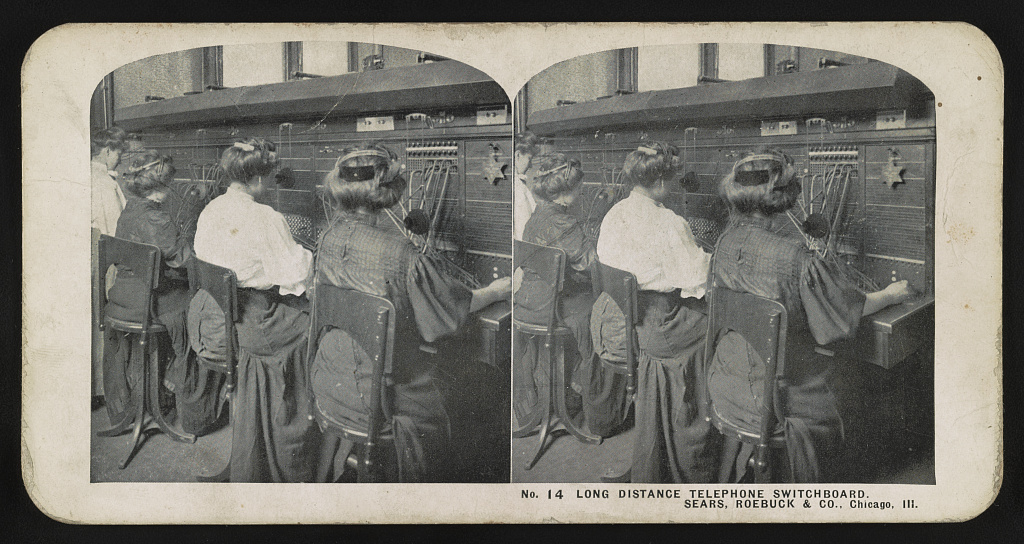
Before automatic exchanges became ordinary, a telephone call often passed through the hands of an operator. Seated at a board, the operator listened and used cords to connect lines. The work demanded speed, memory and steady attention, even when customers experienced the network as an effortless voice at the other end. Women became a large part of this workforce. This Chicago stereograph, published by Sears around the first decade of the twentieth century, brings that labor into view and turns a routine working room into something a viewer could inspect through a stereoscope.
About the picture
The cords hanging below the jack panels were working parts of a telephone network. Operators selected connections rather than merely watching a machine. Paired photographs let a stereoscope give the room an impression of depth, carrying a view of this largely female workplace to people outside it.
The history behind it
Cords, hands and a distant voice
A telephone call once needed a person between the caller and the person being called. An operator listened, selected the right connection and used plug cords at a board. The seemingly repetitive scene on this card is part of the human work behind a growing communications network. Women became prominent in this occupation, while company rules, skill requirements and later automation shaped its working life.
Why Sears appears below the picture
The card is a published object as well as a view of work. Its mount names Sears, Roebuck & Co., and the catalog defines that role as publisher. The scene’s location is separately supported by the Chicago subject headings. Those distinctions prevent an easy mistake: turning the name on a commercial picture into the photographer’s name, or into a contract connecting every worker to that publisher.
A network viewed through a stereoscope
Two closely matched panels let a stereoscope create depth, making the row of operators a scene a viewer could inspect at home. The card’s 1900–1910 interval describes its cataloged publication period. The packet gives no call log, payroll or individual biography. Those would be the next kinds of evidence to seek for a history of this particular room and its workers.
A few things to read next
Books for a longer visit, and a few good places to start online. These are ordinary links, with no affiliate commission.
On the bookshelf
America Calling: A Social History of the Telephone to 1940
How ordinary Americans brought telephones into household and community life.
Hello, Central? Gender, Technology, and Culture in the Formation of Telephone Systems
Telephone work and the gendered organization of early communications systems.
When Old Technologies Were New
How electric communication was imagined and discussed in the late nineteenth century.
Read online
Switchboard operator
A starting point for names, dates and related subjects. Follow its references when you want to go further.
Goodbye, Operator
A history of telephone operators, their working conditions and the gradual arrival of automation.
Telephone
The telephone network and its operators in a particular working institution.
Where the pictures come from
The original records and their individual rights statements are below. The pictures have not been generated or altered for the game.
Long distance telephone switchboard; stereographic card published by Sears, Roebuck & Co. Catalog publication interval: 1900–1910.
Library of Congress, Prints & Photographs Division, Marian S. Carson Collection, LOT 13694 no. 4; LC-DIG-stereo-1s08725 · Between 1900 and 1910
Public domain in the United States by early publication. Item advisory: No known restrictions on publication.
Original editorial digest of the cited sources; not a recovered historical document or independent eyewitness account.
Library of Congress / Data Barnacle source digest · Editorial source digest reviewed 2026-11-01
Original editorial paraphrase of historical facts. The photograph’s rights are stated separately.
Original editorial digest of the cited sources; not a recovered historical document or independent eyewitness account.
Federal Reserve Bank of Richmond; Library of Congress format description / Data Barnacle context · Editorial source digest reviewed 2026-11-01
Original editorial paraphrase of historical facts. The photograph’s rights are stated separately.
History notes and reading lists prepared for Then & Found with AI assistance. The source institutions and authors are not sponsors or endorsers. Suggest a correction or another source