Science & invention 1960s
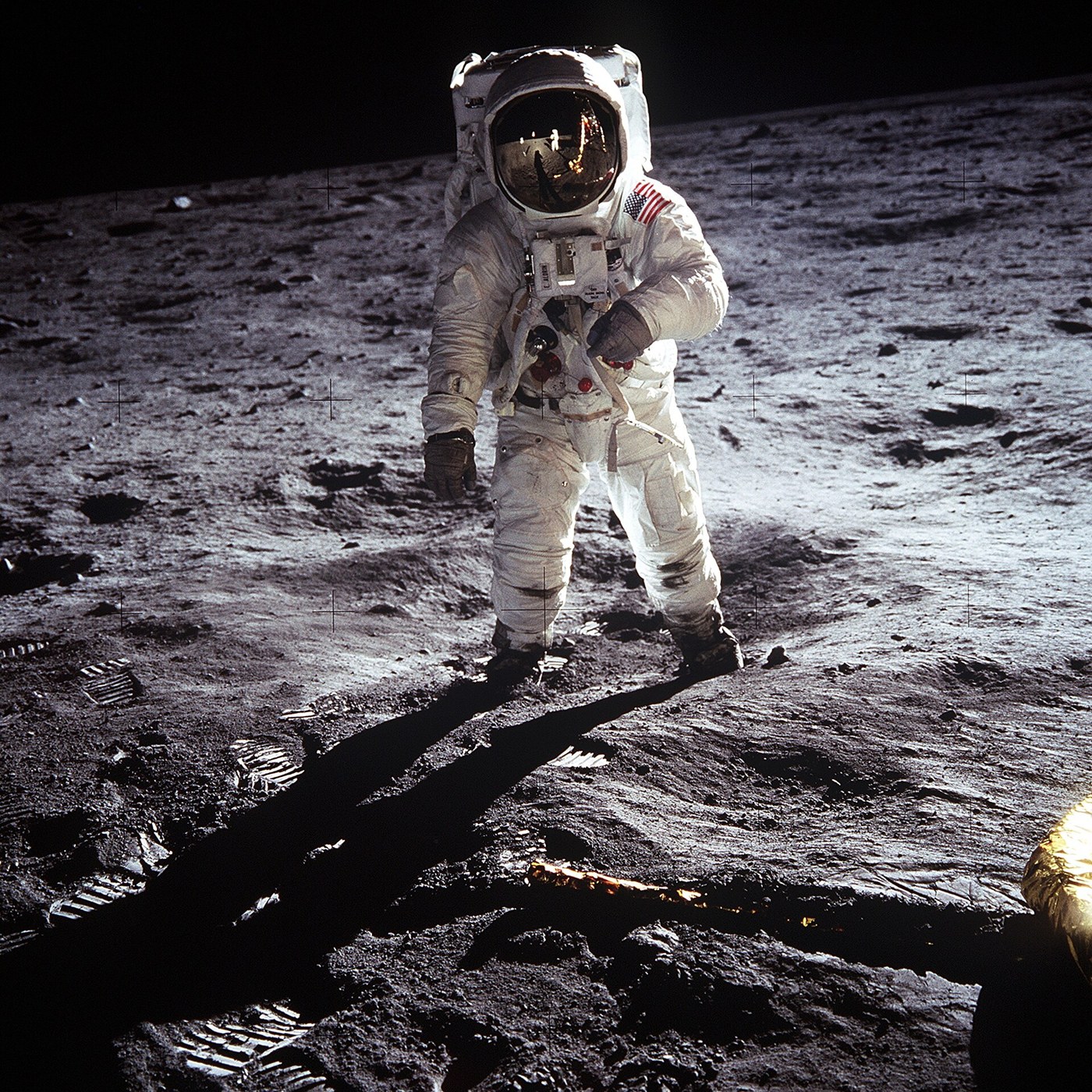
Buzz Aldrin at Tranquility Base
Buzz Aldrin’s reflective visor carries a tiny record of the man taking his picture: Neil Armstrong, standing on the lunar surface. During Apollo 11 in July 1969, the two astronauts worked outside the lunar module Eagle while Michael Collins remained in orbit aboard Columbia. Photography was part of a tightly planned visit that also included collecting samples and placing experiments. The famous portrait makes the expedition seem wonderfully still, but the crews on the surface, in orbit and on Earth were coordinating a complicated journey with little room for error.
About the picture
Armstrong photographed Aldrin near Eagle during the Apollo 11 moonwalk. The visor reflects Armstrong and part of their surroundings, so both moonwalkers are present in the picture. Collins, the third crew member, was flying the command module in lunar orbit and did not descend to the surface.
The history behind it
What the archive establishes
The record is NASA image AS11-40-5903: Armstrong’s portrait of Aldrin during the Apollo 11 surface excursion in July 1969, near Eagle at Tranquility Base. The crew context rules out orbit-only flights, the second landing and the later rover missions. Oceanus Procellarum, Fra Mauro, Hadley–Apennine, Descartes and Taurus–Littrow are credible Apollo near misses, but they belong to other landing missions. The picture’s granular ground, footprints and life-support equipment establish an exterior surface activity; they do not independently name a mission or site. NASA identifies Armstrong and equipment reflected in the visor. The distributed presentation version also has added black framing above the original exposure, so that framing is not treated as historical evidence. No exact day is scored because calendar descriptions depend on the time convention.
Date, place and phase
Armstrong behind the camera, Aldrin as subject and Collins remaining in orbit identify the first landing excursion rather than an orbit-only flight or later landing. The Apollo 11 provenance places the scene near Eagle at Tranquility Base. The other lunar sites offered belong to different landing missions. NASA identifies a surface portrait of Aldrin made by Armstrong. The equipment and footprints support an exterior excursion, but the precise identity follows from the record.
What the frame leaves open
A frame excludes people beyond its boundary. The credited photographer is outside the main image and a third crewmember remained in orbit. The credited photographer was another astronaut. The image does not identify the maker of every footprint. Do not assign an unseen sequence from one portrait. Bright sunlit ground and strong shadows contradict that inference. Exposure and the airless sky differ from familiar terrestrial night scenes.
A few things to read next
Books for a longer visit, and a few good places to start online. These are ordinary links, with no affiliate commission.
On the bookshelf
A Man on the Moon
The Apollo astronauts’ experiences, reconstructed through extensive interviews.
Carrying the Fire: An Astronaut’s Journeys
The mission’s command-module pilot tells his own story of training and flight.
Apollo’s Legacy: Perspectives on the Moon Landings
How the Moon landings have been remembered, argued over and interpreted.
Read online
Apollo 11
A starting point for names, dates and related subjects. Follow its references when you want to go further.
Apollo 11 photographic gallery
Explore the photographs around Aldrin’s portrait, including image AS11-40-5903.
Apollo 11 anniversary account
The mission, its crew and the work accomplished during the first landing.
Where the pictures come from
The original records and their individual rights statements are below. The pictures have not been generated or altered for the game.
Buzz Aldrin during the Apollo 11 lunar surface excursion, photographed by Neil Armstrong, July 1969.
Neil A. Armstrong / NASA, via Wikimedia Commons · July 1969
Public domain
History notes and reading lists prepared for Then & Found with AI assistance. The source institutions and authors are not sponsors or endorsers. Suggest a correction or another source


