Work & everyday life 1940s
The neighborhood business of keeping food cold
Which date belongs to the photograph, and what does the cart actually establish? Read the image and caption record, then test claims about the dealer, the block and nearby households.
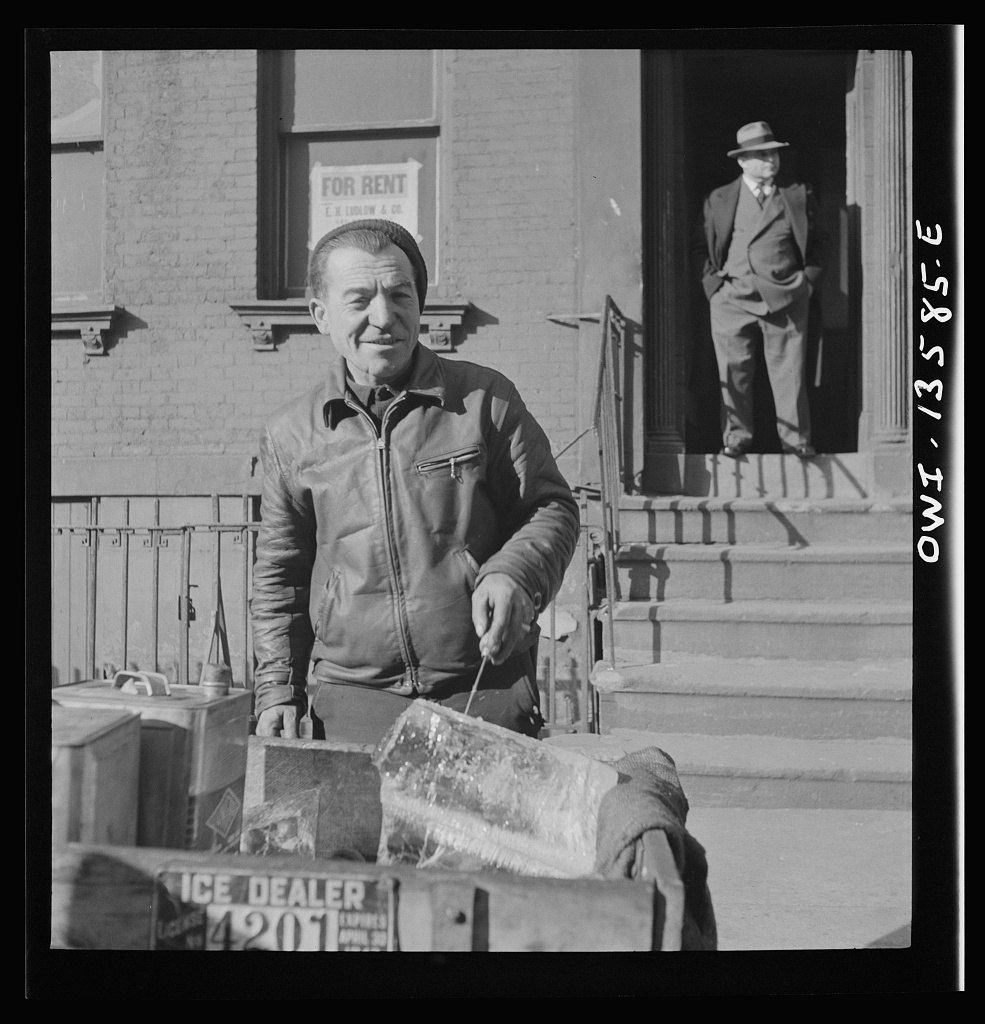
A block of ice could be an ordinary household purchase, as necessary as a food delivery. Inside an insulated icebox, it kept perishable food cool while it slowly melted. Dealers supplied fresh blocks through a network of harvesting or manufacture, storage and local transport. Marjory Collins photographed this Mott Street dealer in January 1943, when electric refrigerators had already been sold for years. His cart is a reminder that new appliances and older services overlapped. Changing technology reached homes and businesses through purchases, habits, costs and the people who did the work.
About the picture
A large clear block rests on the cart outside a brick building. Its journey could involve production, storage, transport and cutting before a customer used it. The dealer is one visible person in that chain. The photograph does not show the cold storage sites or household arrangements at the other end.
The history behind it
An icebox needed a continuing supply
An insulated icebox kept food cool by holding a block of ice in a compartment above or beside its shelves. As that block melted, someone had to remove the water and obtain replacement ice. The National Park Service’s account of a preserved household icebox explains this practical arrangement. Cold storage in the home depended on recurring delivery and maintenance, making the dealer’s work part of food provision rather than an occasional curiosity on the street.
Sources: National Park Service: how an icebox and its supply worked
A block does not disclose its whole journey
Natural ice could be cut during winter and stored under insulation for later use. Mechanical ice-making provided another source. Both routes involved handling and distribution before a block reached a cart. These histories explain plausible supply systems; they do not identify the source of this particular block. The photograph shows an ice dealer and merchandise on Mott Street, but contains no supplier invoice, harvesting record or customer order connecting it to a named pond or factory.
Sources: National Park Service: how an icebox and its supply worked · Library of Congress: Collins’s Mott Street photograph
January 1943 and the separate 1944 transfer
The Library of Congress credits Marjory Collins and dates the photograph to January 1943. Its title locates the scene on Mott Street in New York. A different note records a transfer from the Office of War Information in 1944. These entries describe the making and later custody of the record. Substituting the transfer year for the exposure date would move an ordinary street encounter into the wrong moment of its documentary history.
Sources: Library of Congress: Collins’s Mott Street photograph
Old and new cooling systems overlapped
Electric refrigerators were available before this photograph, with early models sold in the 1910s and broader marketing later. Their existence did not mean every household or business immediately stopped buying ice. The 1943 street trade provides a concrete example of overlapping technologies. It does not measure refrigerator ownership in the surrounding buildings or prove what any particular customer bought the block for. Understanding that transition requires appliance, business and household records as well as a persuasive image.
Sources: National Park Service: how an icebox and its supply worked · Library of Congress: Collins’s Mott Street photograph
A few things to read next
Books for a longer visit, and a few good places to start online. These are ordinary links, with no affiliate commission.
On the bookshelf
Refrigeration Nation: A History of Ice, Appliances, and Enterprise in America
The long transition from traded ice to mechanical refrigeration.
Before the Refrigerator: How We Used to Get Ice
The businesses and practical systems that harvested, stored and delivered ice.
Frostbite: How Refrigeration Changed Our Food, Our Planet, and Ourselves
Follow the history into the enormous modern cold chain behind everyday food.
Read online
Iceman (occupation)
A starting point for names, dates and related subjects. Follow its references when you want to go further.
The Icebox, the Predecessor of Modern Refrigeration
How insulated cabinets, delivered ice and later electric appliances worked.
Free! Winter Images
Historical photographs introduce the labor of cutting, storing and delivering ice.
Where the pictures come from
The original records and their individual rights statements are below. The pictures have not been generated or altered for the game.
New York, New York. Ice man on Mott Street. Photograph by Marjory Collins, January 1943.
Library of Congress, Prints & Photographs Division, FSA/OWI Collection; LC-DIG-fsa-8d24261; LC-USW3-013585-E · January 1943
Public domain U.S. government FSA/OWI photograph. Item advisory: No known restrictions.
Original editorial digest of the cited sources; not a recovered historical document or independent eyewitness account.
Library of Congress / Data Barnacle source digest · Editorial source digest reviewed 2026-11-01
Original editorial paraphrase of historical facts. The photograph’s rights are stated separately.
Original editorial digest of the cited sources; not a recovered historical document or independent eyewitness account.
National Park Service / Data Barnacle historical context · Editorial source digest reviewed 2026-11-01
Original editorial paraphrase of historical facts. The photograph’s rights are stated separately.
History notes and reading lists prepared for Then & Found with AI assistance. The source institutions and authors are not sponsors or endorsers. Suggest a correction or another source
