Markets and media 1890–1900
Bergen’s fish market in photochrom color
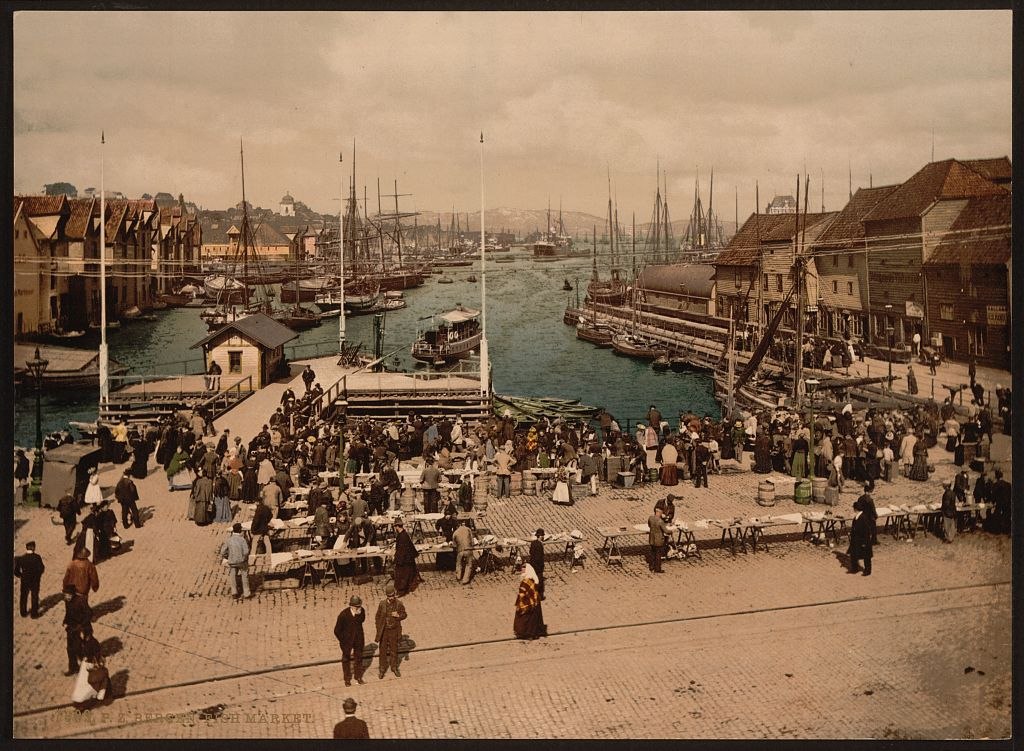
Bergen’s harbor market joined fishing, local farming and town life in one busy place. By the late nineteenth century, the waterfront was also being sold to travelers as a colorful view of Norway. This print was made by the photochrom process: a photographic image became the basis for a color print produced with lithographic stones. The result could look remarkably like a color photograph before modern color photography became ordinary. The scene therefore belongs to two histories at once, the daily work of the market and the commercial trade in picturesque views.
About the picture
The market crowds the triangular waterfront space with people, goods and small boats. Its vivid color came through the photochrom printing process, using separate stones for different colors. These prints carried attractive views of European places to buyers who might never visit, turning a working market into a widely circulated travel image.
The history behind it
The documented reconstruction
This is a circa 1890–1900 photochrom view of Bergen’s fish-market pier. Three pieces work together: the harbor-market arrangement in the image, the catalog’s identification of Triangelen, and its technical description of a photomechanical color print. A later sales catalog helps identify the title without redating the original view to 1905. Nor does the vivid color establish modern color film, exact original hues, the occupation of every person or the day’s sales volume. A useful caption preserves both what can be identified and the uncertainty that remains.
Reading the source
The creation range and the later sales catalog answer different questions. One dates the artifact’s historical production, while the other helps explain its surviving title. The medium adds another layer: a color photomechanical print can communicate a convincing sense of place without making each hue a measured record of the original scene.
Questions for further research
The market is identifiable at the level of place and activity, but it is not a complete social census. Individual figures may be vendors, buyers, port workers or passersby. Their visible presence does not identify each occupation or provide a day’s sales total. Those more detailed questions would need linked market or municipal records. Photomechanical color and catalog dating must be evaluated separately.
A few things to read next
Books for a longer visit, and a few good places to start online. These are ordinary links, with no affiliate commission.
On the bookshelf
Norway: A History from the Vikings to Our Own Times
A broad national history with context for coastal trade, towns and economic change.
The Grand Tour: The Golden Age of Travel
A richly illustrated history of travel imagery, including the world of photochrom prints.
Eyewitnessing: The Uses of Images as Historical Evidence
A useful companion for thinking about how printed views present the life of a city.
Read online
Photochrom
A starting point for names, dates and related subjects. Follow its references when you want to go further.
The photochrom process
How photographs and lithographic printing produced these richly colored views.
The history of Bergen’s fish market
The changing waterfront market and surrounding streets; in Norwegian.
Where the pictures come from
The original records and their individual rights statements are below. The pictures have not been generated or altered for the game.
[Fish market, Bergen, Norway]
Library of Congress, Prints & Photographs Division · [between ca. 1890 and ca. 1900].
No known restrictions on publication.
An original editorial digest of the cited catalog facts; not a second historic eyewitness document.
Library of Congress, Prints & Photographs Division · Editorial digest reviewed 2026-11-01
Original Data Barnacle wording summarizing factual catalog data; underlying artifact rights are stated on the image.
History notes and reading lists prepared for Then & Found with AI assistance. The source institutions and authors are not sponsors or endorsers. Suggest a correction or another source


