Astronomy and print 1700–1799
Beijing’s observatory in an English engraving
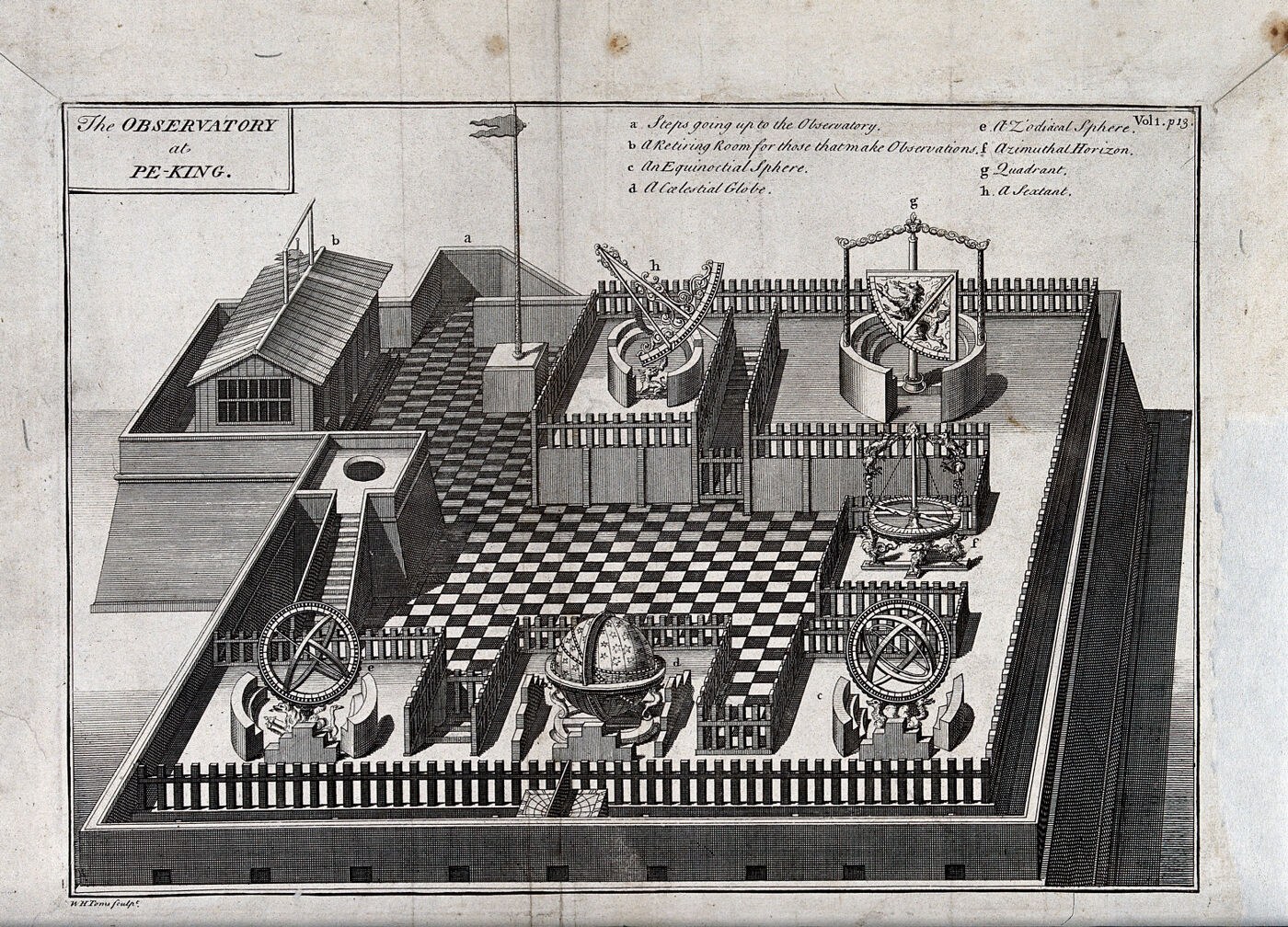
Astronomical instruments on a raised platform made Beijing’s observatory a striking subject for European printmakers. The observatory was part of a long Chinese tradition of observing the heavens and calculating the calendar, a responsibility tied closely to imperial government. Exchanges with Jesuit astronomers added another chapter to that work. W. H. Toms’s eighteenth-century English engraving carried a view of the site to distant readers under the name “Pe-king.” Its journey through print shows how knowledge of a place could circulate far beyond the people who had actually seen it.
About the picture
The instruments and raised observing platform make this image a view of organized astronomical work. Large fixed instruments allowed repeated observations of celestial positions. The English engraving also belongs to the history of geographical publishing, when images of distant scientific sites reached readers through translated accounts and reproduced pictures.
The history behind it
The documented reconstruction
The represented site is Beijing’s observatory, even though the catalog assigns production to England. The old Pe-king lettering and present-day title are consistent ways of identifying the subject. Its medium is equally important: an engraving can organize a complex site into a legible perspective without certifying that its maker stood there or that every activity occurred simultaneously. The production range spans the eighteenth century; neither the image’s detail nor the familiar modern spelling licenses a more precise year. This case turns on separating the origin of a representation from the location and chronology of what it represents.
Reading the source
Historical spellings and modern indexing can describe one location across time. In this packet, Pe-king and Beijing identify the represented observatory, while England identifies the assigned place of production. Treating every place field as a scene address would erase that distinction. The century-wide dating must likewise remain broad unless another reliable source narrows it.
Questions for further research
The engraving’s detail does not make it a timed camera exposure or a measured engineering survey. An artist can arrange instruments and figures for clarity without certifying a single simultaneous event. A claim about the engraver’s travel, instrument performance or construction chronology would need supporting documentation beyond a credit line and a persuasive perspective.
A few things to read next
Books for a longer visit, and a few good places to start online. These are ordinary links, with no affiliate commission.
On the bookshelf
Science and Civilisation in China, Volume 3: Mathematics and the Sciences of the Heavens and the Earth
A major reference on Chinese mathematics, astronomy and related scientific traditions.
On Their Own Terms: Science in China, 1550–1900
Chinese science and its encounters with European learning from the sixteenth to nineteenth centuries.
Eyewitnessing: The Uses of Images as Historical Evidence
Helpful context for using engravings of distant places as historical evidence.
Read online
Beijing Ancient Observatory
A starting point for names, dates and related subjects. Follow its references when you want to go further.
Astronomy: the observatory at Beijing
Explore Toms’s engraving, its cataloged production place and the historical names attached to it.
Prediction and politics in Beijing, 1668
Research on Ferdinand Verbiest, astronomical tests and imperial authority in Qing Beijing.
Where the pictures come from
The original records and their individual rights statements are below. The pictures have not been generated or altered for the game.
Astronomy: the observatory at Beijing. Engraving by W.H. Toms.
Wellcome Collection · 1700-1799
Public Domain Mark — free of known copyright restrictions.
An original editorial digest of the cited catalog facts; not a second historic eyewitness document.
Wellcome Collection · Editorial digest reviewed 2026-11-01
Original Data Barnacle wording summarizing factual catalog data; underlying artifact rights are stated on the image.
History notes and reading lists prepared for Then & Found with AI assistance. The source institutions and authors are not sponsors or endorsers. Suggest a correction or another source