Scientific entertainment 1780s
Selling the wonder of balloon flight in London
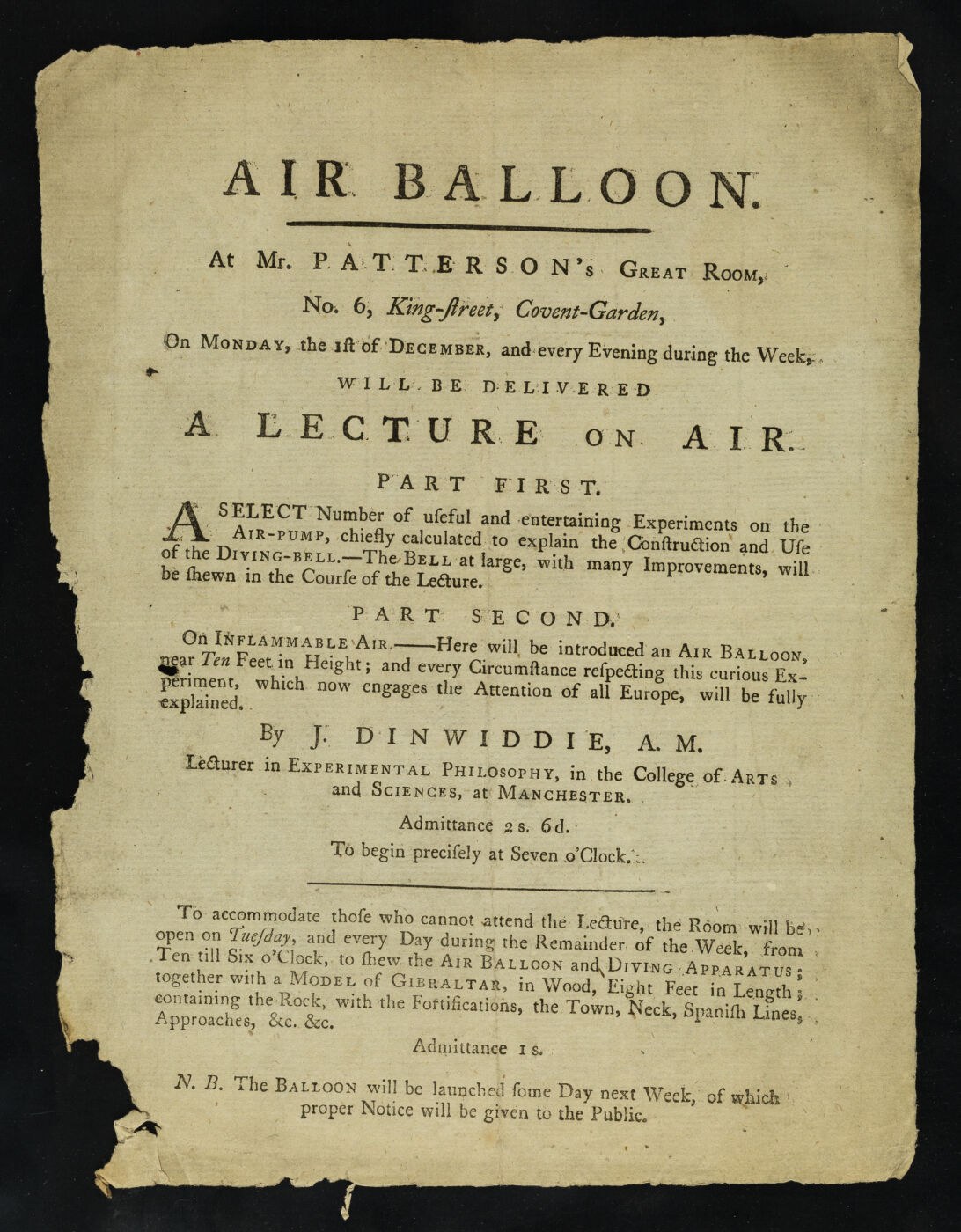
The first human balloon flights in 1783 created an eager audience for explanations of the new machines. In London, lecturer James Dinwiddie advertised an evening talk on air at a room in Covent Garden. His handbill offered both instruction and spectacle: different admissions covered the evening lecture and daytime displays, and a future balloon ascent was promised. It is a small surviving piece of the business of public science. People could pay to watch demonstrations, inspect models and imagine joining the extraordinary new possibility of leaving the ground.
About the picture
Dinwiddie’s handbill sold several experiences at different prices: a lecture in the evening, displays during the day and the prospect of an ascent to come. The mixture of explanation and entertainment helped ballooning reach people far beyond the inventors and experimenters who were building the machines.
The history behind it
The documented reconstruction
The handbill is a promise of scientific entertainment, not proof of a completed flight. Its historical dating is qualified: the catalog brackets 1783 while also describing a possible 1780s context. The venue line points to Covent Garden; Manchester appears in Dinwiddie’s credentials and Gibraltar in a model description. Prices and times likewise belong to two distinct offers. Evening listeners pay 2s 6d for a lecture at seven, while daytime viewers pay one shilling during a ten-to-six opening. The final launch notice remains future tense. No ticket total, successful launch report or exact original printing location should be invented from the advertisement.
Reading the source
The handbill does not contain a single undifferentiated event. It sells an evening lecture, offers a separate daytime display and promises further notice about a future launch. Prices and hours attach to particular offers. The place names also have different jobs: Covent Garden is the venue, Manchester is an affiliation and Gibraltar is the subject of a model.
Questions for further research
Advertisements are evidence for what was offered and how it was framed, not automatic proof of delivery or commercial success. A follow-up investigation would seek a later notice, account or report tied to the launch. The difference between the handbill’s technical wording and a modern catalog’s broad balloon label should also be retained for verification rather than silently edited away.
A few things to read next
Books for a longer visit, and a few good places to start online. These are ordinary links, with no affiliate commission.
On the bookshelf
Falling Upwards: How We Took to the Air
The people, experiments and risks of the early ballooning era.
The Age of Wonder
Ballooning and other sciences within the public imagination of the late eighteenth century.
Printing 1770–1970: An Illustrated History of Its Development and Uses in England
How handbills and other printed matter helped sell public events and new ideas.
Read online
History of ballooning
A starting point for names, dates and related subjects. Follow its references when you want to go further.
Ballooning: First in the Air
The experiments and public excitement surrounding early balloon flight.
Ballooning history timeline
Follow lighter-than-air flight from 1783 through later scientific and sporting uses.
Where the pictures come from
The original records and their individual rights statements are below. The pictures have not been generated or altered for the game.
Air balloon : at Mr. Patterson's Great Room, no. 6, King-Street, Covent-Garden on Monday, the 1st of December, and every evening during the week, will be delivered a lecture on air / by J. Dinwiddie.
Wellcome Collection · Catalog attribution: [1783]; description also allows a possible 1780s date
Public Domain Mark — free of known copyright restrictions.
An original editorial digest of the cited catalog facts; not a second historic eyewitness document.
Wellcome Collection · Editorial digest reviewed 2026-11-01
Original Data Barnacle wording summarizing factual catalog data; underlying artifact rights are stated on the image.
History notes and reading lists prepared for Then & Found with AI assistance. The source institutions and authors are not sponsors or endorsers. Suggest a correction or another source


