Science & invention Circa 1900
The Curies’ electrical measurements
What can a laboratory photograph establish without a sample log? Compare the apparatus, catalog lettering and scientific context, then distinguish the approximate photograph date from later awards.
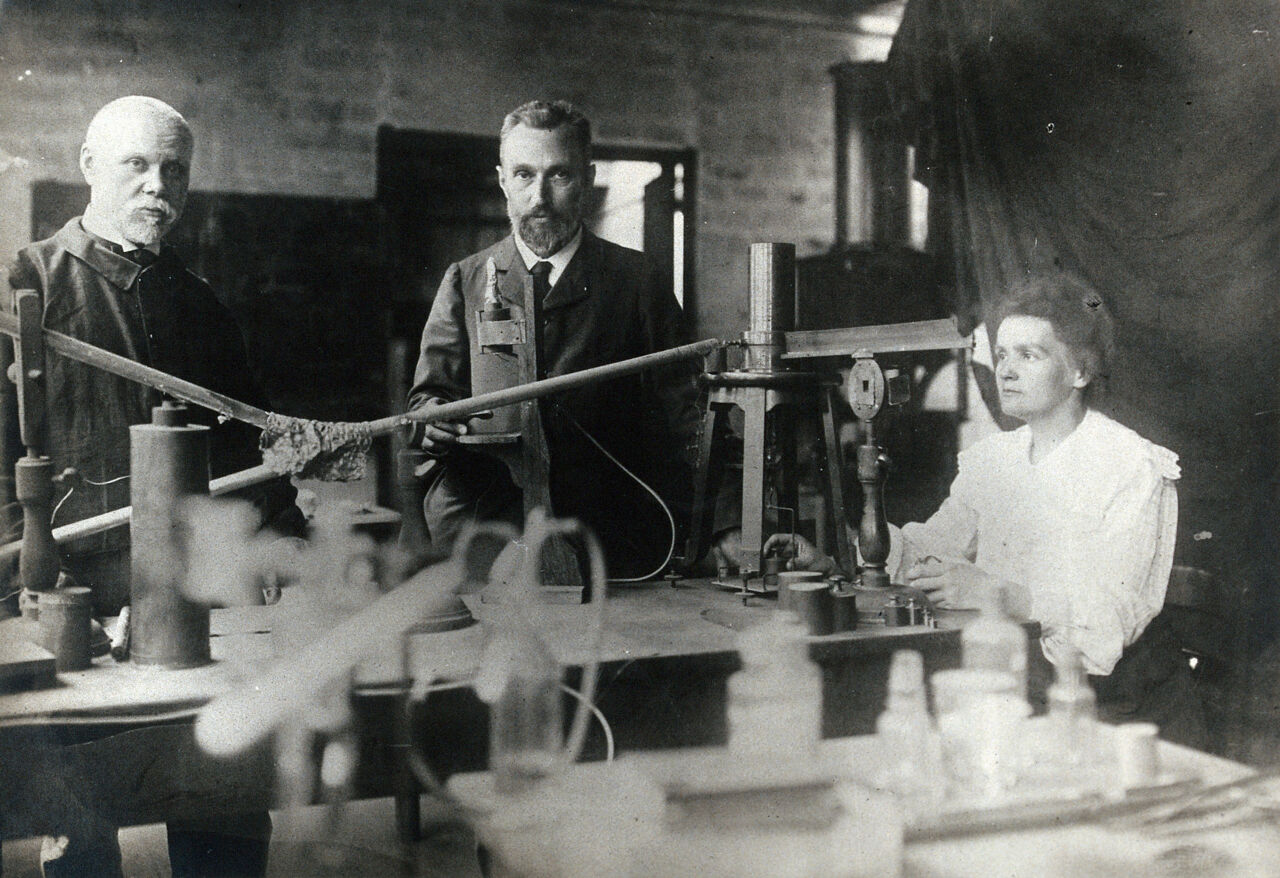
The Curies’ search for new radioactive substances depended on patient comparisons. Chemical work separated materials into different portions; sensitive electrical measurements helped show which portions remained strongly active. This photograph, cataloged around 1900, places Marie and Pierre Curie among the apparatus of a Paris measurement workshop. A third man appears with them, unnamed in the archive. The room brings a famous discovery story down to the scale of tables, wires and instruments. The later Nobel awards recognized the research, but its daily work required repeated procedures and readings rather than one decisive photograph.
About the picture
Marie Curie sits beside a crowded arrangement of measuring equipment, with Pierre standing centrally and another man at the left. The recorded description associates the room with electrometrical measurement. Such measurements made very small effects comparable, helping researchers follow activity through successive chemical separations of a mineral.
The history behind it
Making invisible activity comparable
The Curies could compare radioactive materials through electrical effects in the surrounding air. The American Institute of Physics explains how Marie Curie used a sensitive instrument developed by Pierre and Jacques Curie to measure those small changes. Comparing readings made it possible to ask whether a mineral’s activity could be explained by its known constituents. The apparatus mattered because a visible specimen alone could not show which material produced the measured effect.
Sources: American Institute of Physics: following radioactivity through separation
Chemical separation and measurement worked together
Pitchblende proved more active than its known uranium content could explain. The Curies separated its constituents through chemical procedures, then measured the activity of the resulting portions. Repeating that combination allowed them to follow strongly active material through the separation process. It was an investigation built from comparisons and repeated operations. A photograph of measuring equipment can introduce that method; it cannot stand in for the sample histories, readings and chemical records that made the argument persuasive.
Sources: American Institute of Physics: following radioactivity through separation
What Wellcome identifies, and what it leaves unnamed
Wellcome’s title places Marie and Pierre Curie in a Paris laboratory around 1900, accompanied by another man. Its recorded lettering associates the workshop with electrometrical measurement. That is a useful statement of purpose, but it supplies neither the third man’s name nor an instrument reading for the instant pictured. The approximate date should remain approximate. Identifying every object or participant from a famous discovery story would add details the catalog has not established.
Sources: Wellcome Collection: Paris laboratory photograph and recorded lettering
A laboratory image is not an award photograph
The Science History Institute distinguishes Marie Curie’s shared physics Nobel Prize of 1903 from her chemistry prize of 1911. Those milestones explain the later recognition of the research, not the date of this exposure. The image’s cataloged circa-1900 setting belongs to another kind of record. Reading the photograph alongside the scientific history lets us connect practical laboratory work to the larger achievements without pretending that one photographed session documents the announcement of a discovery.
Sources: Science History Institute: Marie Sklodowska Curie · Wellcome Collection: Paris laboratory photograph and recorded lettering
A few things to read next
Books for a longer visit, and a few good places to start online. These are ordinary links, with no affiliate commission.
On the bookshelf
Marie Curie: A Life
The scientific partnership, family life and institutions surrounding Curie’s work.
Obsessive Genius: The Inner World of Marie Curie
A biography centered on Curie’s work, ambitions and private experiences.
Pierre Curie, with Autobiographical Notes
Curie’s own account of Pierre and their working lives; a primary personal perspective.
Read online
Marie Curie
A starting point for names, dates and related subjects. Follow its references when you want to go further.
The Discovery of Radium: Attacking the Mystery
How electrical comparison and repeated chemical separation worked together.
Marie Sklodowska Curie
The research career, partnership and later Nobel milestones.
Where the pictures come from
The original records and their individual rights statements are below. The pictures have not been generated or altered for the game.
Marie and Pierre Curie with an unnamed man in their laboratory, Paris, circa 1900. Wellcome’s record associates the room with electrometrical measurement.
Wellcome Collection, reference 568772i, image V0030700. Public Domain Mark. · Circa 1900
Public Domain Mark. Wellcome states that this work can be used for any purpose without restriction under copyright law.
Original editorial digest of the cited sources; not a recovered historical document or independent eyewitness account.
Wellcome Collection / Data Barnacle source digest · Editorial source digest reviewed 2026-11-01
Original editorial paraphrase of historical facts. The photograph’s rights are stated separately.
Original editorial digest of the cited sources; not a recovered historical document or independent eyewitness account.
American Institute of Physics and Science History Institute / Data Barnacle research chronology · Editorial source digest reviewed 2026-11-01
Original editorial paraphrase of historical facts. The photograph’s rights are stated separately.
History notes and reading lists prepared for Then & Found with AI assistance. The source institutions and authors are not sponsors or endorsers. Suggest a correction or another source

