Trade and labor 1880–1897
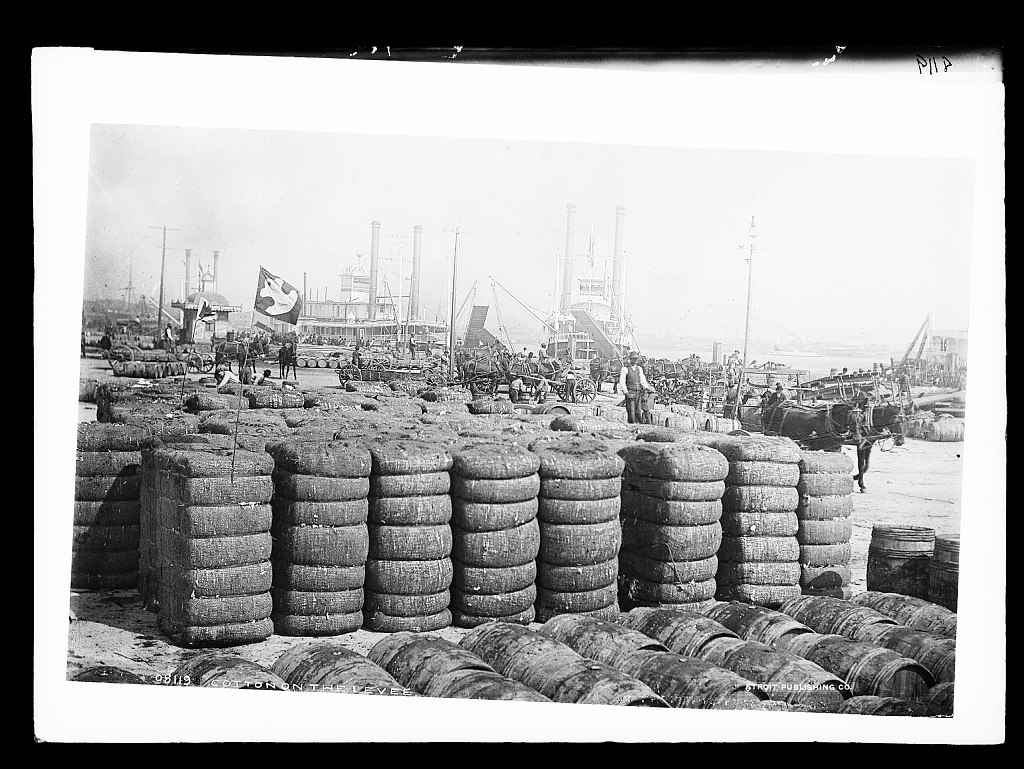
Cotton on the New Orleans levee
Bales of cotton filled the New Orleans waterfront in the late nineteenth century, waiting in the space where river transport met ocean trade. Compressing cotton into bales made a bulky crop easier to store, count and ship. The levee worked as a place of exchange as well as a barrier against the Mississippi. The photograph belongs to the decades after slavery’s abolition, but the trade had grown within an economy built on enslaved labor. Following cotton beyond the waterfront connects this crowded scene with farms, warehouses, textile mills and distant buyers.
About the picture
Packed bales turn the waterfront into a temporary warehouse. Each bale condensed a bulky agricultural product into a unit that could be handled and transported. The photograph preserves one moment in that movement of goods, before mechanized cargo systems and standardized containers changed the appearance and work of major ports.
The history behind it
The documented reconstruction
The defensible reconstruction is a late nineteenth-century New Orleans cotton levee, photographed sometime in the catalog’s 1880–1897 interval. The stacks establish a stage of commodity handling after packing and before any destination can be established from this packet. Jackson’s attribution is supported by an 1898 catalog, while 1949 concerns archival custody. Neither replaces the exposure interval. A crowded riverfront can suggest trade at scale without identifying the owner of each bale, individual employment conditions or an overseas consignee. The harder distinction is between identifying an activity and inventing a transaction history that the photograph does not contain.
Reading the source
The three dates in this packet belong to three documentary acts: making an exposure, publishing an attribution catalog and transferring a negative to an archive. They can all be accurate without being interchangeable. Preserving the interval in an exposure caption is a practical way to show what is known while keeping a later custody event from masquerading as a scene date.
Questions for further research
Commodity identification also has limits. The shape and arrangement of packed bales support a stage in handling cotton, but a photograph is not a bill of lading. A historian seeking destinations, consignees or ownership would look for shipping and business records that can be connected to this particular cargo rather than assuming the photograph contains them.
A few things to read next
Books for a longer visit, and a few good places to start online. These are ordinary links, with no affiliate commission.
On the bookshelf
Empire of Cotton: A Global History
Follows the crop from coerced labor and cultivation into a global manufacturing economy.
River of Dark Dreams: Slavery and Empire in the Cotton Kingdom
The earlier Mississippi cotton economy and slavery that shaped this port’s commercial world.
The Rise and Fall of American Growth
Broader context for the American production, transport and material economy after 1870.
Read online
History of cotton
A starting point for names, dates and related subjects. Follow its references when you want to go further.
Cotton on the levee: original photograph
The archival record and a larger view of the waterfront scene.
Mississippi River Commission history
How levees and river management developed alongside Mississippi settlements and commerce.
Where the pictures come from
The original records and their individual rights statements are below. The pictures have not been generated or altered for the game.
Cotton on the levee
Library of Congress, Prints & Photographs Division · [between 1880 and 1897]
No known restrictions on publication.
An original editorial digest of the cited catalog facts; not a second historic eyewitness document.
Library of Congress, Prints & Photographs Division · Editorial digest reviewed 2026-11-01
Original Data Barnacle wording summarizing factual catalog data; underlying artifact rights are stated on the image.
History notes and reading lists prepared for Then & Found with AI assistance. The source institutions and authors are not sponsors or endorsers. Suggest a correction or another source


