Routes & transport 1910s
Ancon and the opening of the Panama Canal
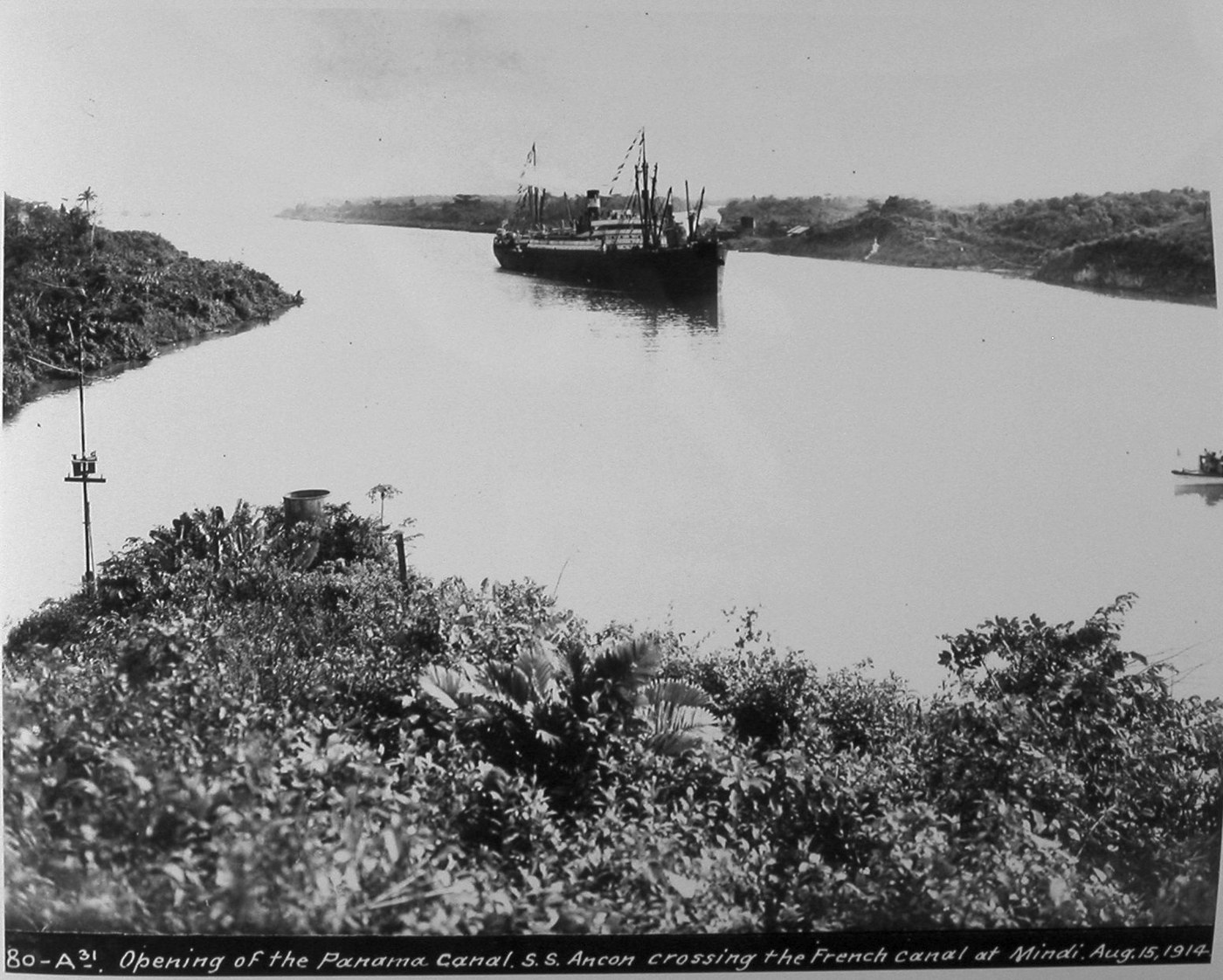
On August 15, 1914, the steamship Ancon made the voyage chosen to mark the Panama Canal’s official opening. The route connected the Atlantic and Pacific across the isthmus, changing the geography of ocean shipping. Getting there had required years of excavation, locks and dams, public-health work and the labor of people recruited from many countries. The opening photograph offers the tidy image of a completed passage. Reading about the construction adds the harder history of disease, unequal working conditions, political power and the landscape that had been remade.
About the picture
Ancon’s August 1914 passage was the official opening transit. Canal work had already involved movements of vessels through parts of the developing system. Here, a steamship moving between steep cut banks makes the scale of the excavation visible: the engineering project had created an entirely new route for seagoing traffic.
The history behind it
What the archive establishes
The original caption places SS Ancon at the French-canal crossing at Mindi on August 15, 1914. The canal authority identifies the official opening transit on that date. Pre-opening tests and trial passages, first-year commercial traffic, early interruptions and later wartime operations are nearby phases rather than interchangeable descriptions of this record. A later Ancon anniversary passage is another real source of possible confusion: the U.S. Army Corps of Engineers illustrates its retrospective history with a 25th-anniversary voyage photograph. Here, however, the retained caption is explicitly the opening-day record. Mindi differs from Gatun, Culebra, Gamboa, Miraflores and Balboa. Banks do not establish a lock chamber, and tropical vegetation cannot uniquely identify the local crossing. The precise vessel, place and date come from the caption and provenance, not the steamship’s profile alone. An official opening transit is not a claim that no vessel had ever traversed any portion of the works earlier.
Date, place and phase
The caption’s August 15, 1914 date matches the official opening. Trial passages, first-year commerce, early closures and later wartime operations are neighboring but different phases. The caption explicitly names the French canal at Mindi. Gatun, Culebra, Gamboa, Miraflores and Balboa are other points, not generic synonyms for this scene. The caption and archive establish the official opening transit by Ancon. The banks alone do not prove a lock operation or identify the vessel uniquely.
What the frame leaves open
The original caption names the French canal at Mindi. Culebra is an important route segment, but not the local point named in this artifact. The frame shows a banked waterway, not visible paired gates and enclosing chamber walls. The caption identifies the Mindi crossing of the former French canal. No loaded-draft measurement is supplied. General vegetation, the visible hull and a route caption do not measure the submerged draft.
A few things to read next
Books for a longer visit, and a few good places to start online. These are ordinary links, with no affiliate commission.
On the bookshelf
The Path Between the Seas
The canal’s long political and engineering history, including the earlier French effort.
The Canal Builders: Making America’s Empire at the Panama Canal
The workers and unequal labor system behind the finished waterway.
Bridging the Seas: The Rise of Naval Architecture in the Industrial Age, 1800–2000
The changing ships and naval engineering that gave canals their commercial importance.
Read online
History of the Panama Canal
A starting point for names, dates and related subjects. Follow its references when you want to go further.
History in pictures: 107 years of the Panama Canal
Historic photographs follow the canal through construction and operation.
End of the Construction
The opening transit and the earlier passages made while the canal was being completed.
Where the pictures come from
The original records and their individual rights statements are below. The pictures have not been generated or altered for the game.
SS Ancon during the opening of the Panama Canal, August 15, 1914. National Archives record 100996344.
Panama Railroad Company / U.S. National Archives, via Wikimedia Commons · 15 August 1914
Public domain
History notes and reading lists prepared for Then & Found with AI assistance. The source institutions and authors are not sponsors or endorsers. Suggest a correction or another source


