Routes & transport 1860s
The railroad meeting at Promontory Summit
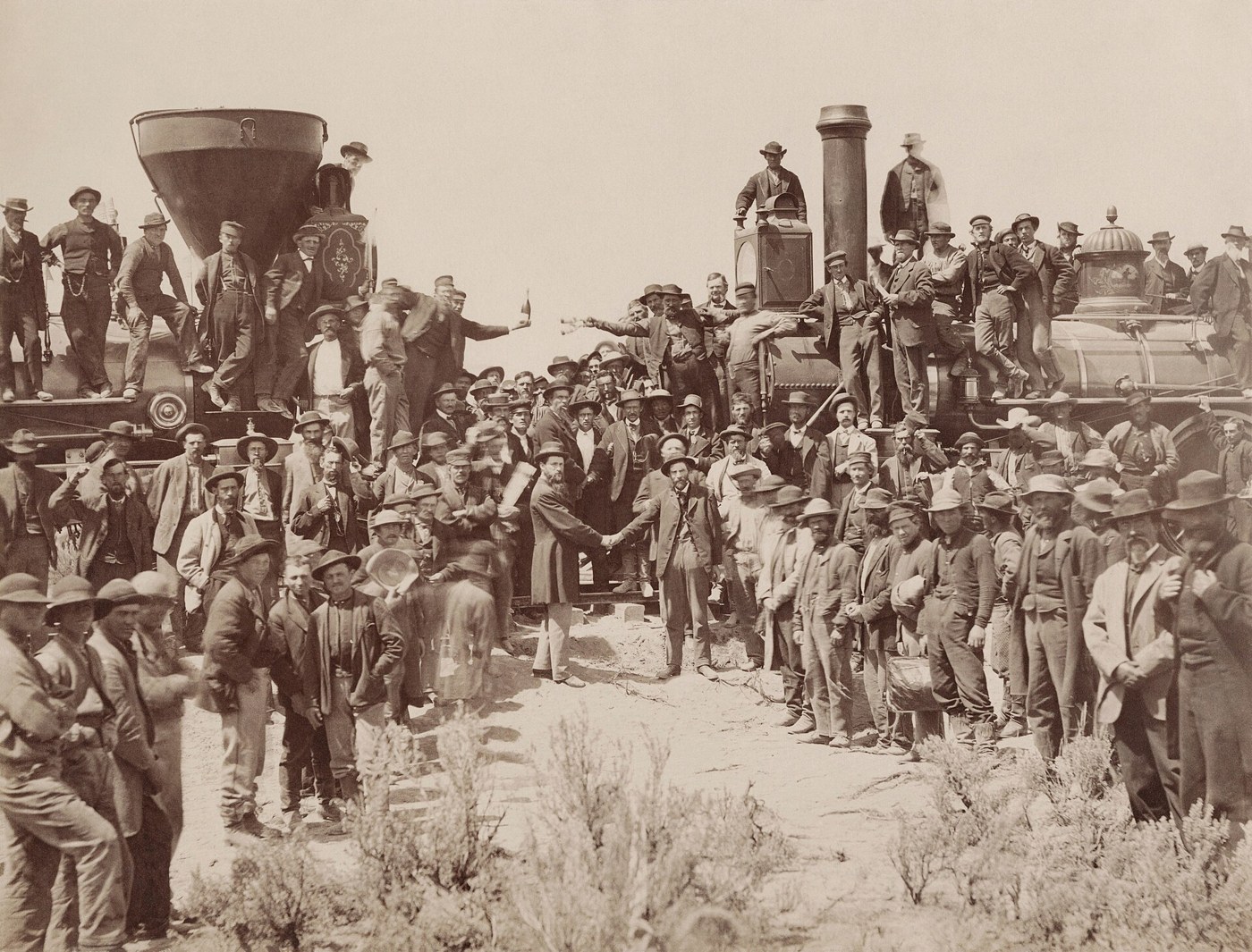
Two locomotives faced one another at Promontory Summit, Utah, on May 10, 1869, as people crowded together to celebrate the meeting of the Central Pacific and Union Pacific railroads. Andrew J. Russell’s photograph helped turn that ceremony into a national image. Behind the posed gathering lay years of surveying, grading, tunneling and track laying, including the work of thousands of Chinese laborers on the Central Pacific. The railroad changed travel and commerce across the West, while its construction also brought land disputes, government subsidies and profound consequences for Indigenous communities.
About the picture
Russell arranged his view around the two engines and the people gathered between them at the last-rail ceremony. The photograph has become shorthand for a much longer construction effort. Its celebratory foreground leaves much of the workforce, and most of the labor that made the meeting possible, outside the frame.
The history behind it
What the archive establishes
Russell’s photograph records the Central Pacific and Union Pacific meeting at Promontory Summit on May 10, 1869. Promontory Point is a different geographic name; Ogden, Sacramento, Omaha and Cheyenne are important railway associations but not this record’s joining site. The posed engines and greeting concern the construction fronts’ meeting, rather than the start of ordinary scheduled service. The subsequent transfer point at Ogden, the much later Lucin Cutoff, a centennial recreation and the earlier Sierra crossing are genuine railway contexts but different milestones. The gathering does not identify the material of a tiny ceremonial spike or function as a complete workforce record. Provenance distinguishes the original ceremony from a reconstruction: the supplied file is a credited restoration of a historical exposure. The joining must not be inflated into an image-based claim about every segment, ferry or connection in a coast-to-coast journey.
Date, place and phase
Russell’s record places the posed meeting at the original 1869 ceremony. A credited digital restoration does not turn it into a modern reenactment. The joining site is Promontory Summit, not Promontory Point, Ogden or the line’s important terminal cities. The ceremony marked the meeting of the Central Pacific and Union Pacific construction fronts. The photograph does not independently prove every connection in a complete coast-to-coast journey.
What the frame leaves open
The record is Promontory Summit. Ogden became the transfer point later; that related operational history is not the location of this exposure. The Lucin Cutoff was a later bypass. The source identifies the original construction-front meeting at Promontory Summit in 1869. The overall scene does not provide enough detail to establish the metal or identity of a small spike. Documentary spike histories should not be treated as directly visible at this scale.
A few things to read next
Books for a longer visit, and a few good places to start online. These are ordinary links, with no affiliate commission.
On the bookshelf
Empire Express: Building the First Transcontinental Railroad
A detailed narrative of the people and work behind the first transcontinental line.
Railroaded: The Transcontinentals and the Making of Modern America
A critical history of railroad finance, subsidies and the reshaping of the West.
California: A History
Useful regional context for the Central Pacific and California’s railroad entrepreneurs.
Read online
First transcontinental railroad
A starting point for names, dates and related subjects. Follow its references when you want to go further.
Golden Spike National Historical Park
The May 1869 meeting and the preserved ceremony site.
The transcontinental railroad
Construction, the Sierra crossing and the workers behind the completed connection.
Where the pictures come from
The original records and their individual rights statements are below. The pictures have not been generated or altered for the game.
Golden spike ceremony, Promontory Summit, Utah, May 10, 1869. Andrew J. Russell; digital restoration by Adam Cuerden.
Andrew J. Russell / Yale University Libraries; restoration Adam Cuerden, via Wikimedia Commons · 10 May 1869
Public domain
History notes and reading lists prepared for Then & Found with AI assistance. The source institutions and authors are not sponsors or endorsers. Suggest a correction or another source


