Public spectacles 1850s
Inside the Great Exhibition of 1851
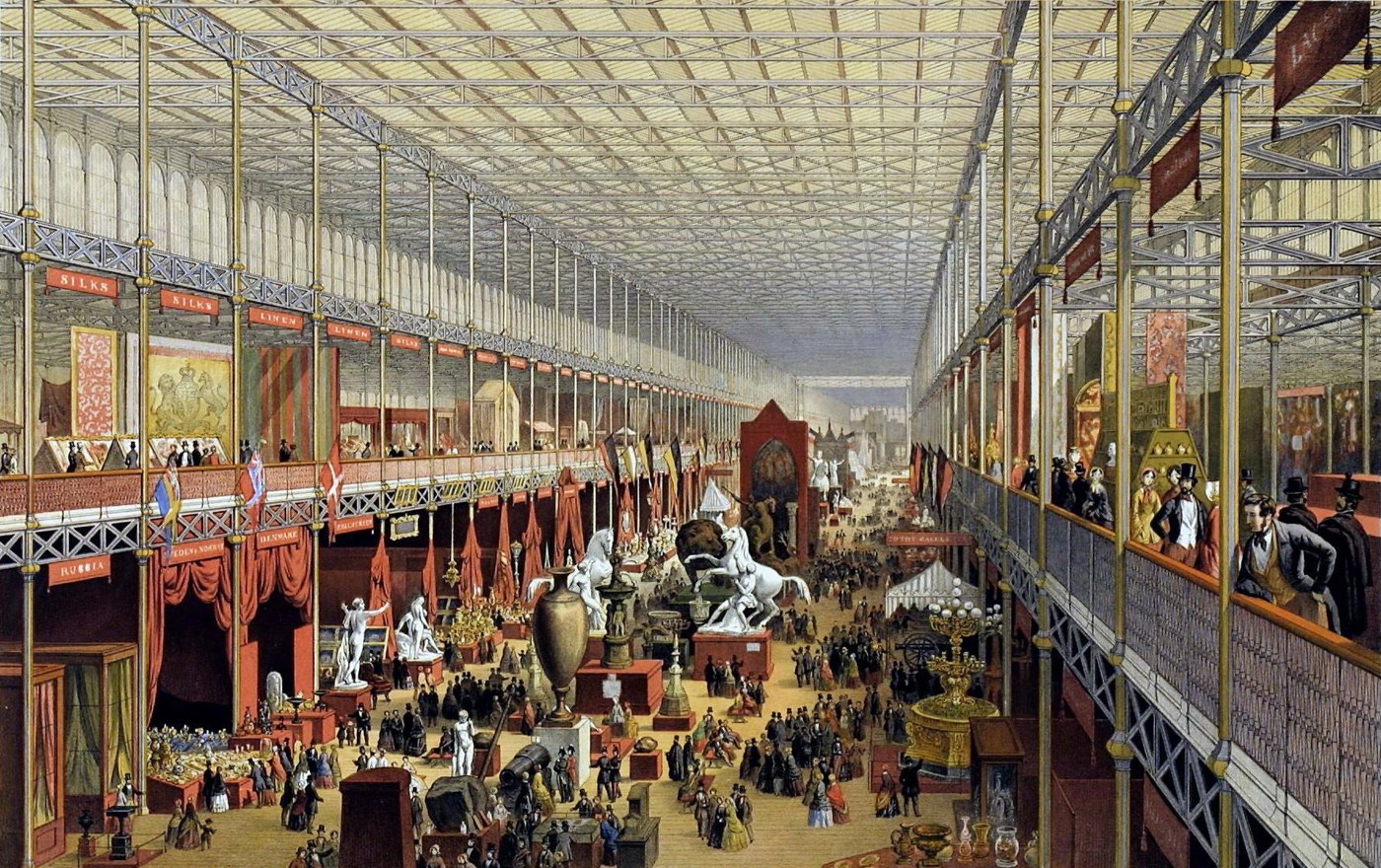
In 1851, visitors entered an enormous iron-and-glass building in London’s Hyde Park to inspect goods gathered from around the world. The Great Exhibition arranged manufacturing, design and national ambition beneath the roof of the Crystal Palace. J. McNeven’s colored lithograph looks along the Foreign Department toward the transept, turning a crowded display into an orderly, luminous interior. The original building was later dismantled and rebuilt at Sydenham, where it reopened in 1854. That second life is often confused with the short-lived Hyde Park exhibition shown here.
About the picture
McNeven’s image is a colored lithograph, a print made to circulate a view of the exhibition. The glass roof and repeated iron supports create a vast, bright interior for manufactured objects. This was the original Hyde Park building of 1851, before the Crystal Palace’s reconstruction at Sydenham.
The history behind it
What the archive establishes
McNeven’s colored lithograph records the Foreign Department at the original Hyde Park Crystal Palace during the Great Exhibition of 1851. The catalog specifies a view toward the transept. A British Department view and a view of the central transept are credible alternatives within the same original building, while the later Sydenham courts are related but different settings. Arranged display bays and visitors fit the public exhibition of foreign industrial and decorative objects, rather than pre-opening installation or post-closing removal. The Royal Collection dates the relocated palace’s reopening to 1854; later industrial and historical-art displays should not be projected into this earlier print. This is an interpreted printed view, not a color photograph. Architecture alone does not prove a precise department; the source identification supplies that distinction.
Date, place and phase
The dated lithograph belongs to the original 1851 exhibition. The later Sydenham reopening and the 1936 fire are phases of the relocated building. The selected record identifies the Foreign Department looking toward the transept. British Department and central transept views exist too, so similar architecture is not a unique locator. Organized displays and visitors fit the public foreign-contributor exhibition. Installation, clearance, British-only displays and later Sydenham courts are distinct activities or divisions.
What the frame leaves open
The print belongs to the original 1851 Hyde Park exhibition. The later courts are a credible related setting, but not this record’s location or phase. That is a real related exhibition view, but the selected artifact is cataloged as the Foreign Department looking toward the transept. Similar roofs cannot resolve the difference without the record. The record establishes a colored lithograph. It does not establish color-by-color fidelity to every exhibited object; the print is a representation.
A few things to read next
Books for a longer visit, and a few good places to start online. These are ordinary links, with no affiliate commission.
On the bookshelf
The Great Exhibition of 1851: A Nation on Display
The exhibition as an event that helped Britain describe itself to visitors.
Britain, the Empire, and the World at the Great Exhibition of 1851
Essays about the imperial and international relationships behind the displays.
Printing 1770–1970: An Illustrated History of Its Development and Uses in England
The printmaking world that produced and circulated illustrated exhibition views.
Read online
Great Exhibition
A starting point for names, dates and related subjects. Follow its references when you want to go further.
The Great Exhibition of 1851
The event’s organization, building and remarkable range of exhibits.
The royal and imperial visit to the Crystal Palace
The building’s later life at Sydenham, after the Hyde Park exhibition.
Where the pictures come from
The original records and their individual rights statements are below. The pictures have not been generated or altered for the game.
Interior of the Crystal Palace during the Great Exhibition, London, 1851. Colored lithograph by J. McNeven.
J. McNeven / Victoria and Albert Museum, via Wikimedia Commons · 1851
Public domain
History notes and reading lists prepared for Then & Found with AI assistance. The source institutions and authors are not sponsors or endorsers. Suggest a correction or another source


