Cities & construction 1880s
Building the Eiffel Tower, 1888
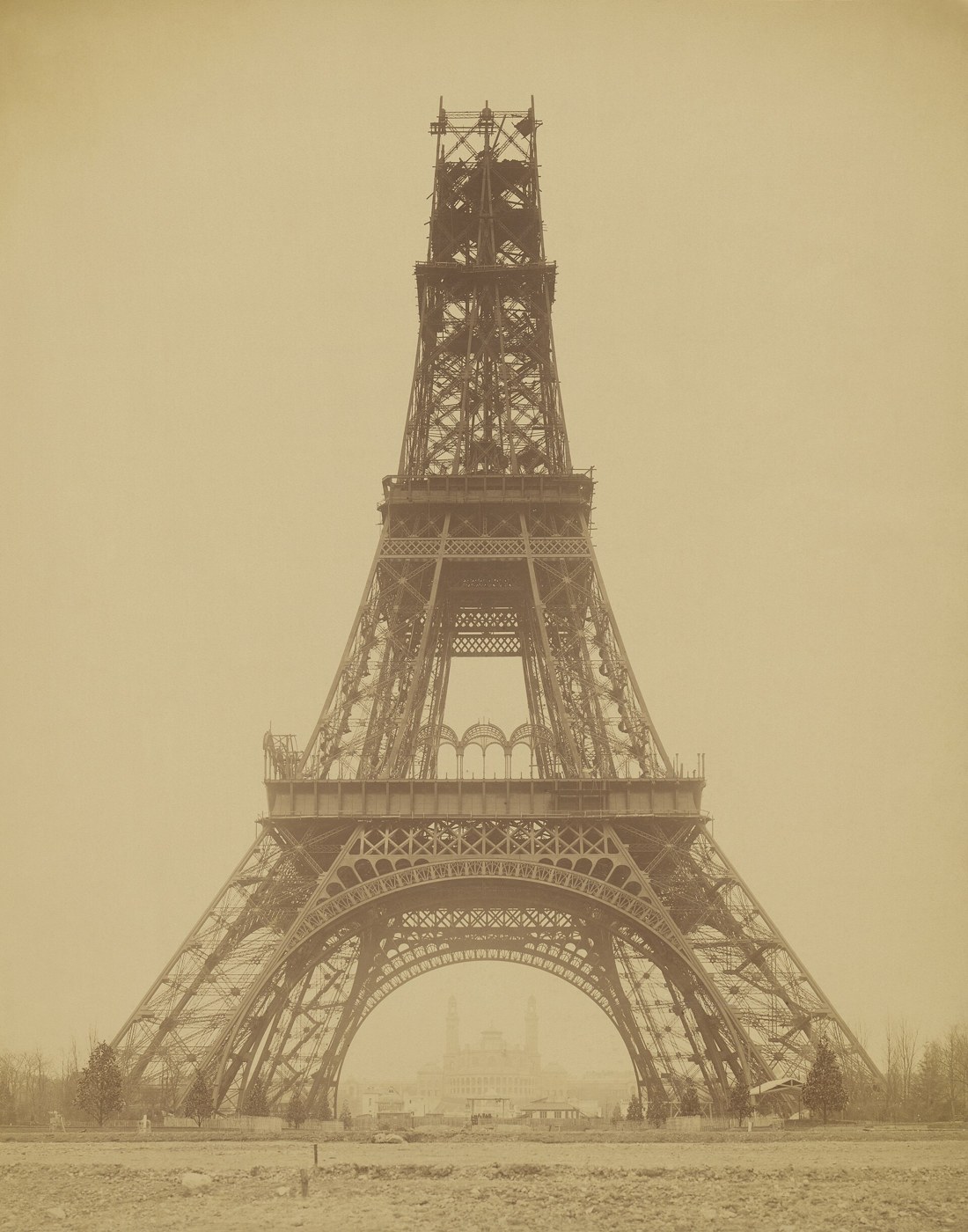
The Eiffel Tower was still a building site when Louis-Émile Durandelle photographed it in November 1888. Its broad lower legs and two platforms were in place, but the narrow upper section had yet to reach its full height. The work rose on the Champ de Mars for the Paris Exposition of 1889. Making such a conspicuous iron structure into the fair’s centerpiece was a bold choice: prominent critics objected to its appearance. The construction photographs preserve a Paris landmark at a moment when its future shape was still being assembled overhead.
About the picture
Durandelle’s November 23 photograph falls between completion of the second floor in August 1888 and the summit in March 1889. The exposed structure makes the tower’s method legible: iron members assembled into an open lattice, with the narrowing upper works still to come above the wide lower platforms.
The history behind it
What the archive establishes
Durandelle’s November 1888 construction view belongs after the tower’s second platform and before summit completion. The operator dates the first floor to April 1888, the second to August 1888 and final assembly to March 1889. The primary operation recorded is structural erection: substantial lower platforms are present while the upper ironwork remains unfinished. This is different from initial foundations, fitting out a complete summit, adding radio equipment or maintaining a finished attraction; the image does not rule out smaller concurrent tasks. The Champ de Mars is the former military ground on the École Militaire axis, not the Trocadéro across the river or the other nearby exhibition sites. The place is established by the monument and sourced geographic context, not by a legible street sign. This familiar artifact is rated Standard; no hidden camera position or arbitrary exact day is scored.
Date, place and phase
The November 1888 source date and unfinished upper work fall after the second platform but before the summit completion of March 1889. The tower stands on the Champ de Mars, the former military ground on the École Militaire axis. Trocadéro is across the river; the other alternatives are distinct nearby Paris sites. The unfinished upper silhouette records structural erection above established lower platforms, rather than work on an already complete visitor attraction. Smaller concurrent construction tasks cannot be excluded.
What the frame leaves open
The tower was erected on the Champ de Mars, on the École Militaire side of the river. The opposite-bank Trocadéro is a nearby but different exposition site. The lower platforms and unfinished upper work belong to the original erection sequence. The source is not a later maintenance record. A construction photograph has a boundary and an instant of exposure. The packet provides no complete worker roll or record of who was outside the view.
A few things to read next
Books for a longer visit, and a few good places to start online. These are ordinary links, with no affiliate commission.
On the bookshelf
Eiffel’s Tower
The tower’s construction and the people who gathered around the 1889 fair.
Gustave Eiffel
An engineering biography that places the Paris tower within Eiffel’s wider career.
Eyewitnessing: The Uses of Images as Historical Evidence
A guide to reading construction photographs as records of work and public display.
Read online
Eiffel Tower
A starting point for names, dates and related subjects. Follow its references when you want to go further.
History and construction of the Eiffel Tower
The official construction account, including dated stages and the 1889 opening.
Parc du Champ-de-Mars
The changing uses of the ground beneath the tower; in French.
Where the pictures come from
The original records and their individual rights statements are below. The pictures have not been generated or altered for the game.
Eiffel Tower construction, Paris, November 23, 1888.
Louis-Émile Durandelle / Getty Open Content, via Wikimedia Commons · 23 November 1888
Public domain
History notes and reading lists prepared for Then & Found with AI assistance. The source institutions and authors are not sponsors or endorsers. Suggest a correction or another source


